All of us undomesticated writers

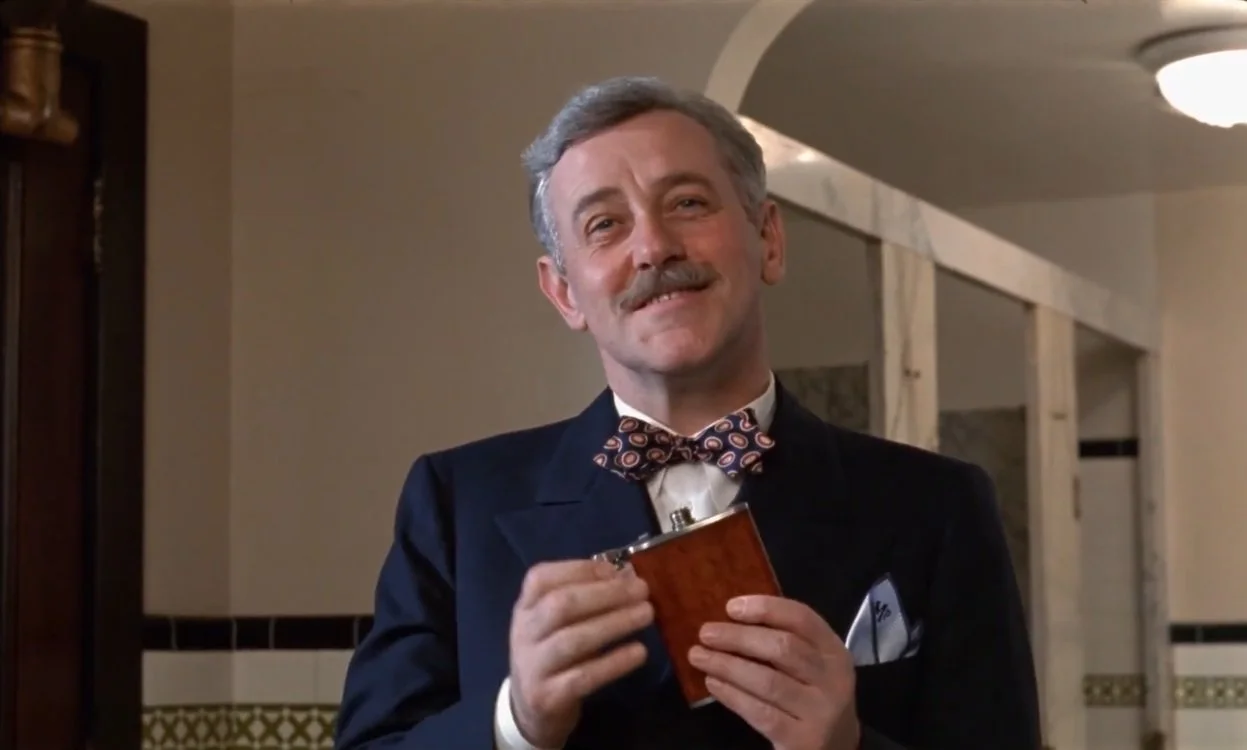
John Mahoney as W.P. Mayhew in Barton Fink (1991)

In Barton Fink, one of my favorite movies, put-upon playwright Fink has relocated from New York to LA to work “in pictures” as a screenwriter. He’s overawed and unsure of himself. Then, in a chance encounter in the bathroom of a swanky Hollywood restaurant, he meets WP Mayhew, an acclaimed Southern novelist of modernist gothic literary fiction (and a souse—a great souse) clearly modeled on Faulkner. They have this exchange:

Barton: I had no idea you were in Hollywood.

WP [producing a flask]: All of us undomesticated writers eventually make our way out here to the great salt lick. Must be why I always have such a powerful thirst.

Annoyingly, this line has been recorded on the internet—at IMDb, in the Google AI summary, and elsewhere—as “make our way out here to the Great Salt Lake.” This is annoying not only because it’s inaccurate, but because it makes nonsense of a nice bit of dialogue, one that demonstrates the Coens’ powers of specificity.

Mayhew could simply have said that he’s working for Hollywood because he needs the money. That’s the import of his line, and his personal problems will have an important role to play later in the movie. But phrasing it this way does a several things at once:

First, it reveals character. Remember, this scene is his introduction. On the most superficial level, he is a Southerner. The self-deprecation, implying that he is in some way untamed, a sort of unapologetic apology, and the agricultural image sound right in his mouth. The Coens have always been minutely attentive to dialect and, paired with John Mahoney’s performance and accent, their writing here makes WP an instantly and utterly believable character.

Related—a subpoint of the above—WP’s ability to switch registers from high to low, which we get more of throughout the rest of the scene, is indicative of his education and literary talent. He’s capable of both rhetorical flight and the prosaic or crude. This duality will came back later in the movie.

Thematically, WP’s cattle metaphor plays into the movie’s already established satirical theme of the way Hollywood treats writers and, in WP’s specific case, reveals his dismissive attitude. He recognizes what Hollywood is doing, feels above this sort of thing, and can be wry about it. (And wry understatement of this kind is, in character terms, exactly right for this kind of Southerner.)

Finally, it introduces WP’s drunkenness, which, like Hollywood’s treatment of him, he shows he is aware of while treating it as a joke. The nice construction of the joke (salt… thirsty… ha!) also downplays just how bad his problem is. And like his treatment by the studio, he is content to do nothing about it.

That’s a lot going on in two sentences. (At least, if you understand and record them accurately.) Masterful work—not least because it seems so natural and effortless when you watch it—and something to strive for in one’s own writing.

I’ll also add that it’s funny—the whole scene is, including WP’s introduction barfing in a toilet stall while kneeling on a monogrammed hankie and Fink’s awkward, starstruck gushing once he realizes who he’s talking to. Unfortunately I can’t find anything more than a shot or two in trailers or video essays, so I’ll just have to encourage y’all to watch Barton Fink if you haven’t. Just be sure, as I advised in my Coen’s ranking post linked above, to watch it knowing as little about it as possible.


Me and the Southern accent

Last month on his microblog, Alan Jacobs linked to this short Atlantic piece—now paywalled—about the slow extinction of the Southern accent. Quoting the author of the essay on the decline of distinctive Southern accents among the young and the eventual reality that the accents will only survive among the old in out-of-the-way places, Jacobs noted, “I’m part of the trend too: I certainly have a Southern accent, but it’s not as pronounced as it was when I was younger, and I profoundly regret that.”

Likewise and likewise. The regret is painful.

My speech, like Jacobs’s, is identifiably Southern to outsiders, but largely through syntax (e.g. double modals), vocabulary (e.g. y’all, fixing to), and peculiarities of emphasis (e.g. saying umbrella instead of umbrella). My accent, in terms of pronunciation, is limited to ineradicable features like the long I noted in that Atlantic essay, yod-dropping, hanging on to the H in wh- words, and the occasional dropped G. I have neither a drawl nor a twang.

This is a regret to me because I feel it severs me from previous generations and the place I come from in one of the most fundamental ways. We learn speech at our mother’s breast and from those closest to us, not only in terms of family but in physical proximity. Gradually losing that means losing a part of me that participates in them and in home.

And I cherish those accents—of which The Atlantic rightly notes there are many. I learned two kinds of Georgia accent growing up. My dad’s parents, natives of Clarke County and the Athens area, spoke a lot like Flannery O’Connor—a Savannah native with her own peculiarities of pronunciation—does in this recording, a soft, non-rhotic accent that outsiders read as genteel. My maternal grandparents, Rabun County natives, spoke in a strongly rhotic accent with heavy Appalachian features. Both of these are from “north Georgia,” broadly speaking, but couldn’t be more different. Southern accents have immense county-by-county variety.

Generation adds more variation. My parents’ accents, both still marked by their parents’ roots, nevertheless grew toward each other, and my own is a yet finer blend—dominated by my maternal side’s Appalachian terseness. It comes out when I try to say iron (arn) or Florida oranges (Flarda arnjes).

In old home movies I have a shrill, squeaky, very country little voice. I’m not sure when the most obvious marks of family and home began to fall away, but it must have been around middle or high school. Unlike the writer in The Atlantic, it was never intentional. I never wanted to blend in, was never ashamed of being Southern—far from it, I grew a sizable chip on my shoulder during an undergrad career surrounded by Yankees and Midwesterners who thought nothing of moving South and mocking the locals for saying umbrella—and, if anything, I wanted more of an accent than what I ended up with.

Faking it is not, I decided long ago, an option. Better to let it emerge occasionally, a nice surprise. (I’ve noticed myself, in the classroom, pronouncing opportunity without the R lately, a real surprise.) I try to comfort myself with examples of other provincials who unintentionally lost their accents—namely CS Lewis, a Belfast native who, quite unconsciously, slowly conformed to the speech of whomever surrounded him and ended up sounding like this.

But when I remember my grandparents’ voices, and talk to my parents and aunts and uncles and siblings, and think about those home movies, and then recall my own kids’ sweet speech—in which very little Southern remains—all I can do is regret. Time isn’t the only thing that gets away from us. And this, the Ubi sunt? sense of loss, is perhaps the only thing more Southern than the accent I used to have.